The Senquip QUAD-C2 can communicate with the Senquip Portal or a remote server using Wi-Fi and cellular networks. Cellular connectivity is provided using LTE Cat-M1 and LTE Cat-1 technologies, offering a balance between coverage, power consumption, and performance for telemetry and monitoring applications.
Wi-Fi on the Senquip QUAD-C2 is used to transmit data, to allow settings to be remotely updated, to allow in-field software updates and also to enable setup via an integrated web-server that can be accessed in setup mode via a mobile phone or other Wi-Fi device.
The Wi-Fi implementation supports Wi-Fi 802.11 b/g/n. The Wi-Fi antenna is integrated into the Senquip QUAD-C2. In typical applications, the range achievable with Wi-Fi is 500m.
In the absense of Wi-Fi, the QUAD-C2 will attempt to connect using a local cellular network. Senquip devices use cellular networks to transmit data, to allow settings to be remotely updated, and to allow in-field software updates.
The QUAD-C2 cellular implementation is designed for global use and supports Cat-M1 and CAT-1 in the following bands:
The Senquip device provides the following network interfaces:
Interface
Purpose
Cellular
Secure communication with the Senquip Cloud and
customer-configured endpoints.
Wi-Fi
Secure communication with the Senquip Cloud and
customer-configured endpoints.
Bluetooth Low Energy
(BLE)
Local commissioning and configuration using the
Senquip Connect App.
Wi-Fi Access Point
Local commissioning and configuration in setup mode.
Network services exposed by the device include:
Service
Availability
Embedded Webserver
Available in setup mode and protected by the device
setup password.
BLE Configuration
Service
Available in setup mode and protected by the device
setup password.
MQTT Client
Outbound communication to authorised cloud or
customer-configured endpoints.
HTTP/HTTPS Client
Outbound communication to authorised cloud or
customer-configured endpoints.
The device does not provide SSH, Telnet, FTP, remote shell access, or support for arbitrary user-installed network services.
All Senquip Cloud communications use authenticated and encrypted communications. Customer-configured endpoints and services are the responsibility of the endpoint owner.
When connected to a Wi-Fi network, the Senquip QUAD-C2 may need to establish secure outbound connections to Senquip services. If your network uses a firewall, the following outbound ports should be permitted.
Function
Port
Description
NTP Time
123
Synchronises the device clock. Accurate time is required for timestamping measurements
and for security functions such as certificate validation.
MQTT (Senquip
Portal)
8883
Secure communication between the device and the Senquip Portal.
HTTPS (OTA Updates)
443
Used for Over-the-Air (OTA) firmware updates and other secure web services.
Note
These ports are used for outbound connections only. No inbound ports need to be opened on your firewall.
Note
If custom endpoints are enabled, additional ports may need to be opened.
The following Wi-Fi authentication modes are supported:
WPA
WPA2
WPA3
Connecting to a Wi-Fi or LTE Network with the Senquip Connect App
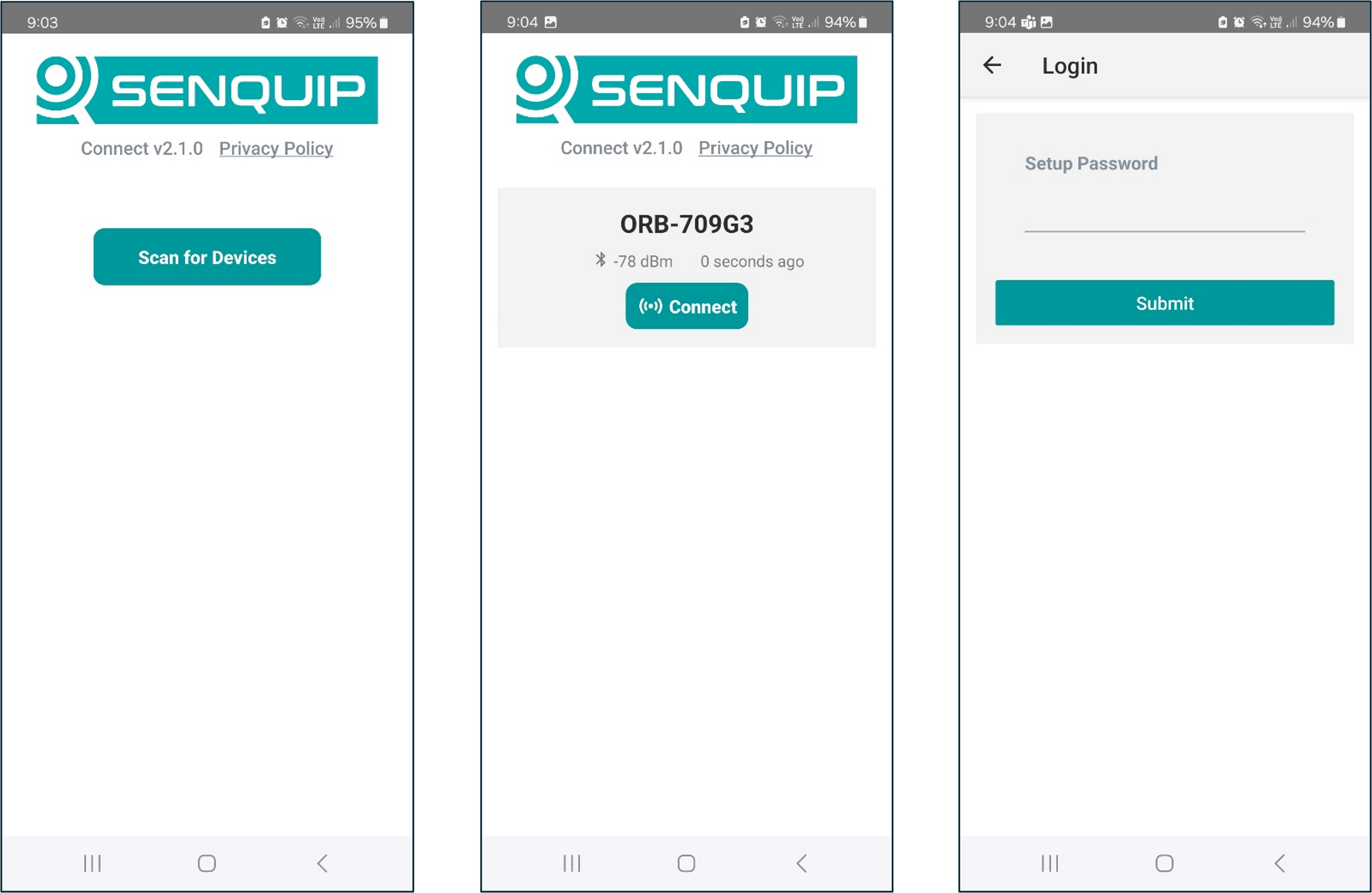
The Senquip Connect App is a mobile application that allows users to connect to nearby Senquip devices using Bluetooth to configure networks and for data viewing. The app is available for both Android and iOS devices running recent firmware. See the Senquip Device Firmware Changelist for more information on compatible firmware versions.
Network configuration via Bluetooth is available when the Senquip device is in setup mode. To enter setup mode, press the setup button on the device. The green light will start to flash. Open the Senquip Connect App and scan for available devices. Devices in setup mode will allow connection for the purpose of network configuration. Press connect and enter the device setup password.
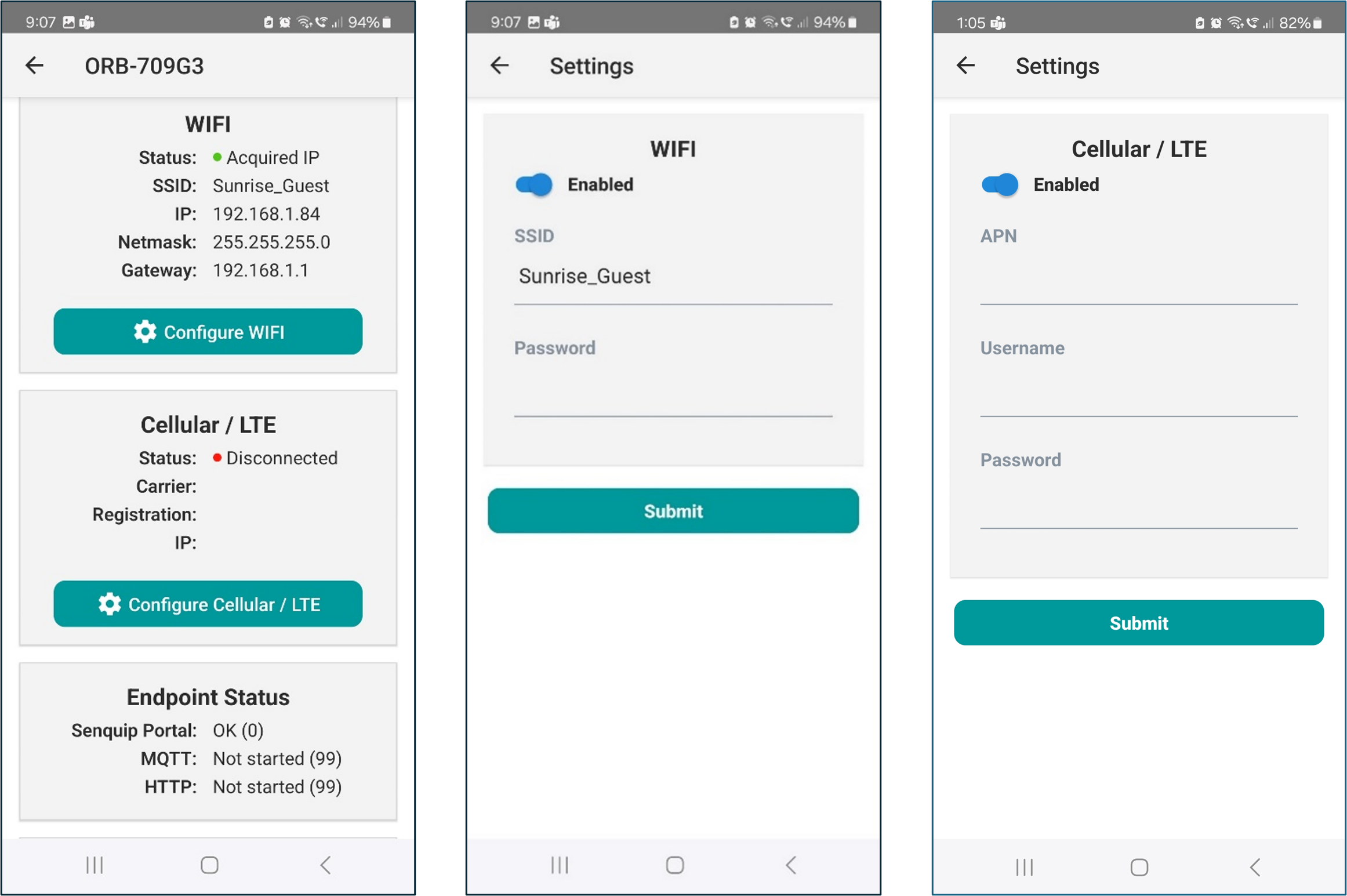
For Wi-Fi networks, the chosen SSID and password need to be entered. Further advanced Wi-Fi settings are available when using the embedded webserver or Senquip Portal for configuration.
For LTE networks, Auto APN can be enabled in which case the device will attempt to find a suitable APN for the network. Alternatively the APN for the network should be entered. In rare cases, a username and password are required for the SIM.
Press Submit to send the settings to the device. The device will save the settings and will reboot back into setup mode. To exit setup mode, press reset on the device. Continue device configuration using the Senquip Portal.
Connecting to a Wi-Fi Network with the Embedded Webserver
Once in setup mode, use the Network page to connect the Senquip QUAD-C2 to a Wi-Fi network.
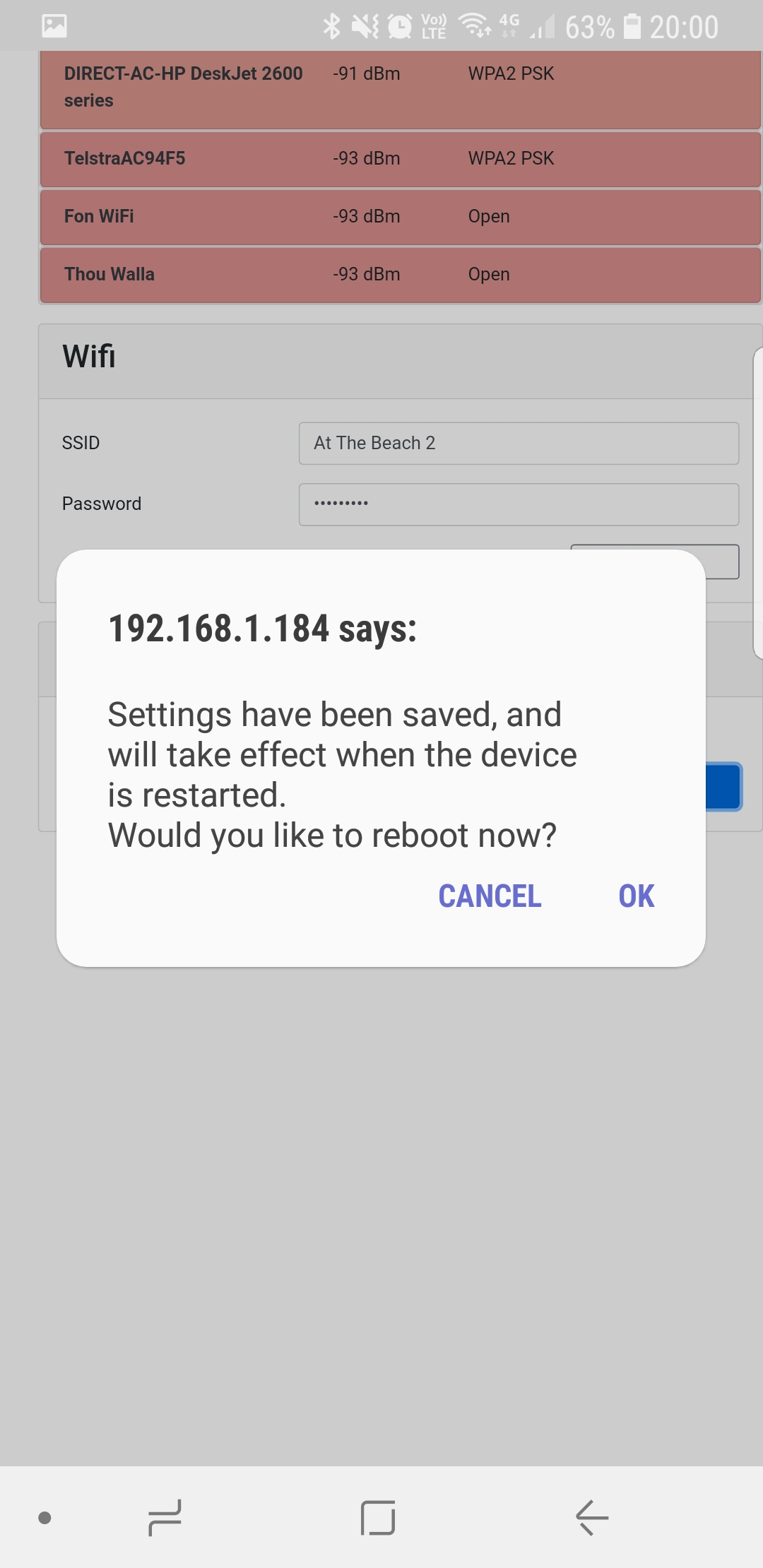
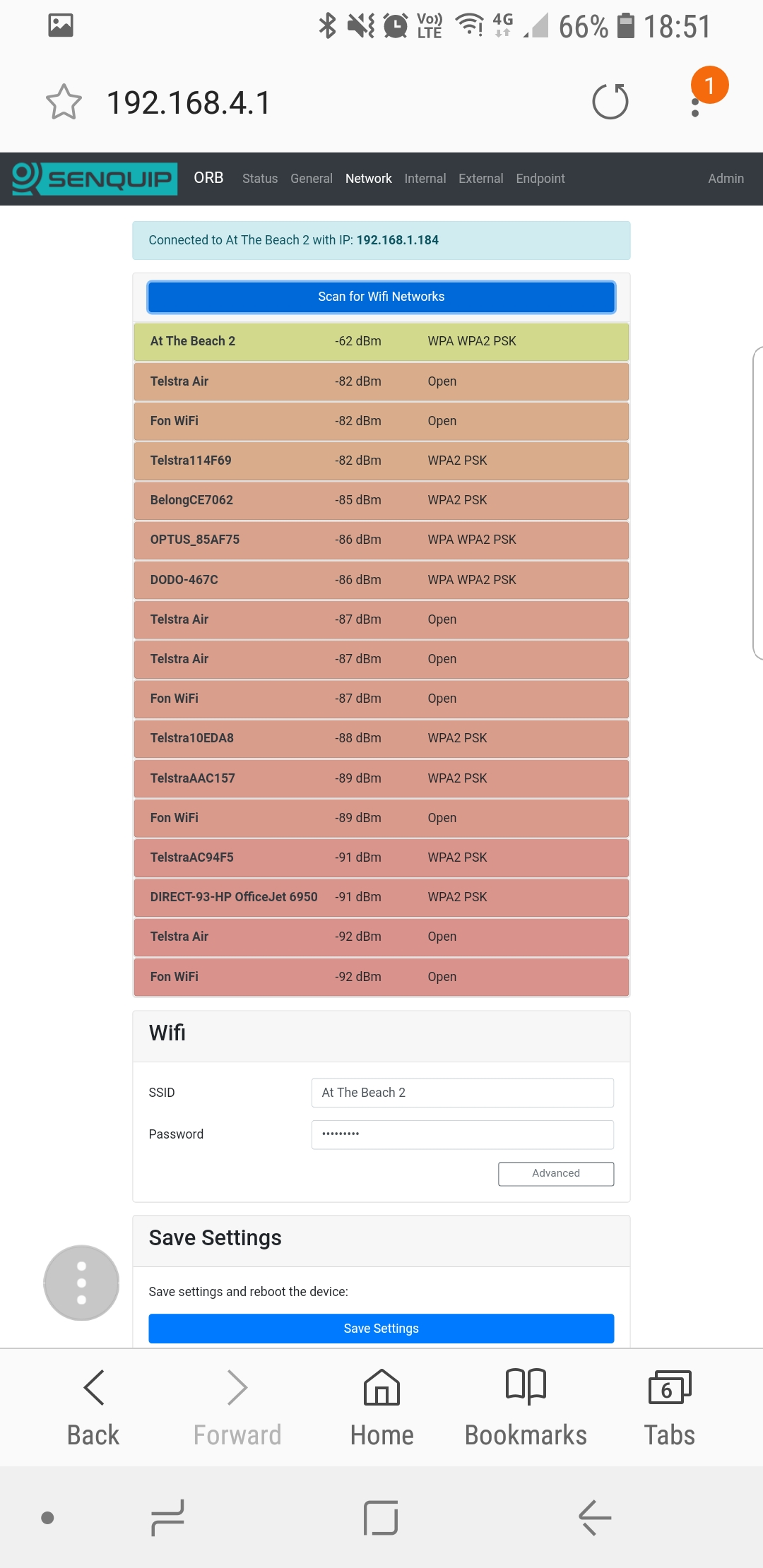
On the Network page, press the Scan for Wi-Fi Networks button. After a few seconds, a list of SSIDs for visible Wi-Fi networks will be shown. Select the Wi-Fi network to which you would like to connect by selecting the SSID from the list. The SSID will automatically be copied to the Wi-Fi SSID field and you will be prompted for the network password. After entering the password, press Save Settings. You will be prompted to restart the device; settings will only be applied after a restart. To continue with setup, press CANCEL or to restart and apply your settings, press OK.
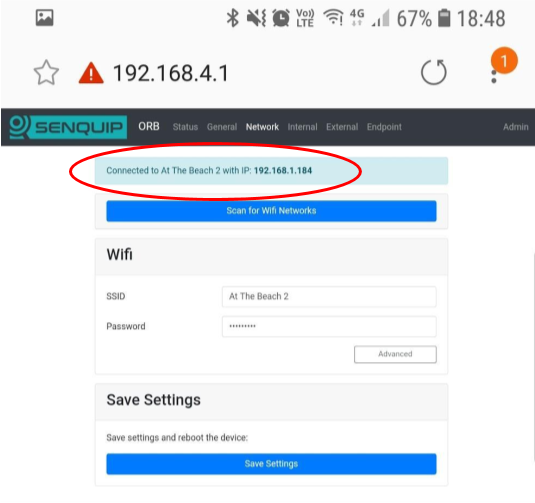
After a reboot, the Senquip QUAD-C2 will attempt to connect to the specified Wi-Fi network. You can check if the Senquip QUAD-C2 has successfully connected to the chosen network by placing the device in setup mode and returning to the Network page. At the top of the page, the current network status will be shown. Note the IP address that your Wi-Fi modem has allocated to the Senquip QUAD-C2; you can use this address to access the device directly on your WiFI network.
Further Wi-Fi settings are available by selecting the Advanced option. Once selected, a static IP address, netmask, gateway and DNS server can be specified.
The integrated web-server is normally only active in setup mode; it can however be made to be always on by setting the web setting to ON. This may be an advantage in systems where permanent power is available and the user wants to be able to make remote changes directly on the Senquip QUAD-C2 without having to access the Senquip Portal. Keeping the web-server active will require that the device remain awake at all times but does mean that the user can make instant changes to settings and see the latest measured data.
A full list of Wi-Fi settings is given in the table at the end of the chapter.
Connecting to an LTE Network with the Embedded Webserver
Once in setup mode, use the Network page to connect the Senquip QUAD-C2 to a mobile network.
In most cases only an APN will be required to establish a 4G LTE connection. Some service providers will require a username and password and some SIM cards will require a pin. If these are not needed, leave them blank.
For CAT-1 devices, an additional Connection Mode setting is available. This setting allows the selection of 4G or 2G, 3G, 4G mobile technology. 4G offers higher bandwidth and is recommended unless there are initial connection issues.
A Roaming option is available for SIM cards that offer connection to networks other that SIM card home network.